If you’ve watched your lawn thin out year after year despite regular mowing and watering, the problem probably isn’t above the ground — it’s underneath it. Loudoun County’s soil is notorious among local landscapers for one particular trait: heavy clay content that compacts easily and squeezes the oxygen right out of your grass’s root zone. Roots that can’t breathe can’t grow, and grass that can’t grow eventually gives up, leaving room for weeds, bare patches, and runoff during storms.
The fix is not another round of fertilizer or a new sprinkler schedule. It’s core aeration, paired with overseeding, done at the right time of year. For lawns in Ashburn, Leesburg, Sterling, South Riding, and everywhere in between, that time is fall. Here’s why, and what it actually involves.
Northern Virginia sits on soil that’s heavier in clay than the sandy or loamy soils found in other parts of the country. Clay particles are small and pack together tightly, which means there’s very little pore space left for air, water, and nutrients to move through. Every time someone walks across the yard, a mower rolls over it, or kids and pets use it as a play space, that soil gets pressed down a little more.
Over time, this compaction creates a kind of ceiling just below the surface. Grass roots hit it and stop growing deeper, which means they can’t reach the water and nutrient reserves lower in the soil profile. Shallow-rooted grass is the grass you see struggling every August — the first to brown out in a dry spell and the last to bounce back.
Add in Loudoun County’s specific mix of new-construction subdivisions (where topsoil is often stripped or compacted by heavy equipment during building) and established neighborhoods with decades of foot traffic, and you have a region where lawn compaction isn’t the exception. It’s closer to the rule.
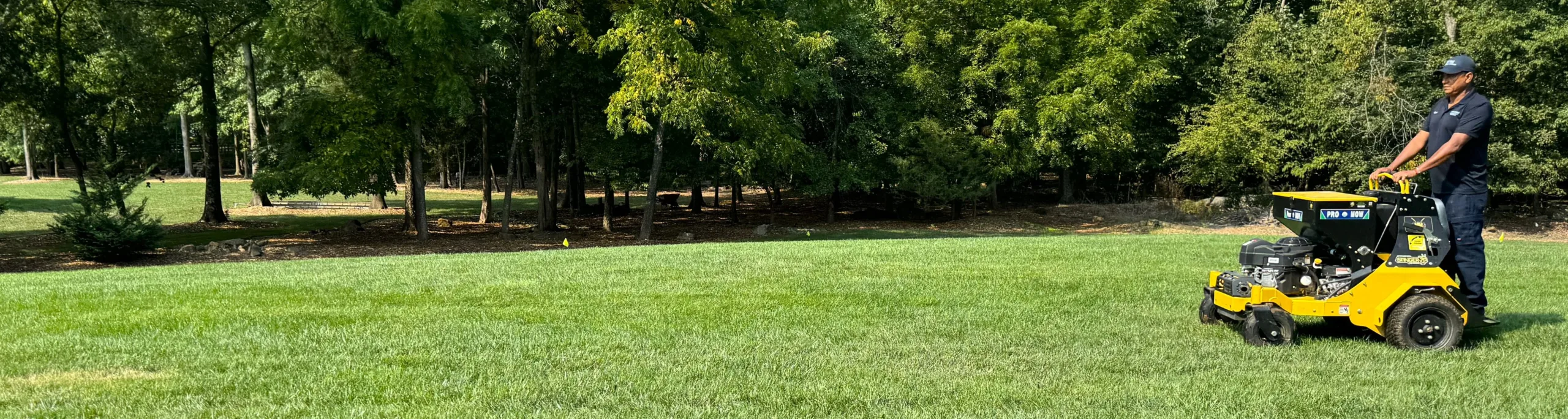
Core aeration is a mechanical process that pulls small plugs — or “cores” — of soil and thatch out of the lawn and deposits them on the surface, where they break down naturally over the following couple of weeks. This isn’t the same as spike aeration, which just pokes holes into the ground and can actually make compaction worse by pushing soil sideways. Core aeration physically removes material, opening real channels for air, water, and nutrients to reach the root zone.
Those holes do double duty. In the short term, they relieve the pressure that’s been suffocating your grass roots. In the slightly longer term, the soil plugs left on the surface break down and return organic matter to the lawn, which improves soil structure over time. It’s a simple mechanical fix with a compounding biological benefit.
When done correctly and at the right time of year, core aeration delivers benefits that go well beyond a slightly less crunchy lawn underfoot:
Timing matters as much as the process itself, and for Loudoun County, that window is early-to-mid fall, roughly September through October.
Here’s the reasoning. Loudoun County lawns are almost universally cool-season grasses — tall fescue, with some Kentucky bluegrass and fine fescue mixed in. Cool-season grasses have two natural growth surges each year: a smaller one in spring and a much stronger one in fall, once summer heat breaks. Aerating during that fall growth surge means the grass is actively putting energy into root and shoot development, so it recovers from the aeration process quickly and uses the newly opened soil to expand its root system before winter.
Fall also brings the weather conditions aeration needs to work well:
Compare that to aerating in spring or summer: spring aeration competes with weed germination (you’re opening up prime real estate for crabgrass and other summer weeds right when they’re trying to establish), and summer aeration stresses grass that’s already fighting heat and drought.
A quick note on conditions, not just the calendar: soil should be moist but not soggy when you aerate. Local lawn care crews generally aim to aerate a day or two after a good rain, or will recommend light watering the day before if the ground has been dry. Aerating bone-dry, rock-hard soil is far less effective, since the machine can’t pull clean cores.
A proper core aeration and overseeding visit typically follows this sequence:
It’s tempting to treat aeration and overseeding as two separate line items, but skipping the seeding half leaves most of the value on the table. Here’s why they’re really one process.
Grass seed needs three things to germinate reliably: good seed-to-soil contact, consistent moisture, and protection from drying out or being eaten by birds. Broadcasting seed onto an established, undisturbed lawn fails on the first count — most of that seed just sits on top of the thatch layer and never makes contact with actual soil, so germination rates are disappointing no matter how good the seed is.
Aeration solves that problem directly. Each core hole is essentially a small, protected pocket of loosened soil, and seed that lands in or near those holes gets exactly the contact and protection it needs. This is why aeration and overseeding done together consistently outperform either service done alone — the aeration creates the opportunity, and the seeding capitalizes on it.
Overseeding in fall also lets you gradually upgrade your lawn’s genetics. Modern tall fescue varieties bred for disease resistance and drought tolerance can be introduced into an existing lawn a little at a time, every year, without ever needing to tear out and replant from scratch. Over a few seasons of consistent fall aeration and overseeding, a lawn’s overall composition shifts toward these hardier varieties, which means less disease pressure and less water stress long-term.
There’s a density argument here too. Bare and thin spots aren’t just cosmetic — they’re an open invitation to crabgrass, clover, and other weeds looking for uncontested soil. Overseeding fills those gaps with grass instead, and a dense stand of turf is one of the most effective, lowest-maintenance weed barriers available.
The few weeks after service matter almost as much as the service itself:
How often should I aerate my lawn in Loudoun County?
Most lawns in this area benefit from aeration and overseeding once a year, in the fall. Lawns with heavier clay soil, new construction lawns, or yards with a lot of foot traffic sometimes benefit from a light spring aeration as well.
Can I aerate and overseed at the same time?
Yes — in fact, that’s the recommended approach for cool-season lawns. Seeding directly into freshly aerated soil produces significantly better germination than either service done on its own.
Will aeration hurt my lawn?
No. It looks disruptive for a short period, but the soil plugs break down within about two weeks, and most lawns look noticeably better than before within that same window.
What if I just fertilize instead of aerating?
Fertilizer applied to compacted soil has nowhere to go — it mostly stays on the surface or washes away in the next rain. Aeration opens the soil so fertilizer, water, and seed can actually reach the root zone where they do the most good.
A great lawn in this part of Virginia isn’t an accident, and it isn’t something you can mow or water your way into if the soil underneath is compacted. Fall core aeration and overseeding address the actual root of the problem — literally — by opening up clay-heavy soil, introducing better-adapted seed, and giving your lawn the conditions it needs to build a deep, resilient root system before winter sets in.
Pro-Mow has been doing exactly this for Loudoun County lawns for over 35 years, as a family-owned, locally operated business that understands this soil and this climate because we’ve been working in it for three and a half decades. If your lawn has been thinning out or struggling through the summer heat, a fall aeration and overseeding service is the single highest-impact thing you can schedule this season. Request a quote to get your lawn on the calendar while the fall window is still open.