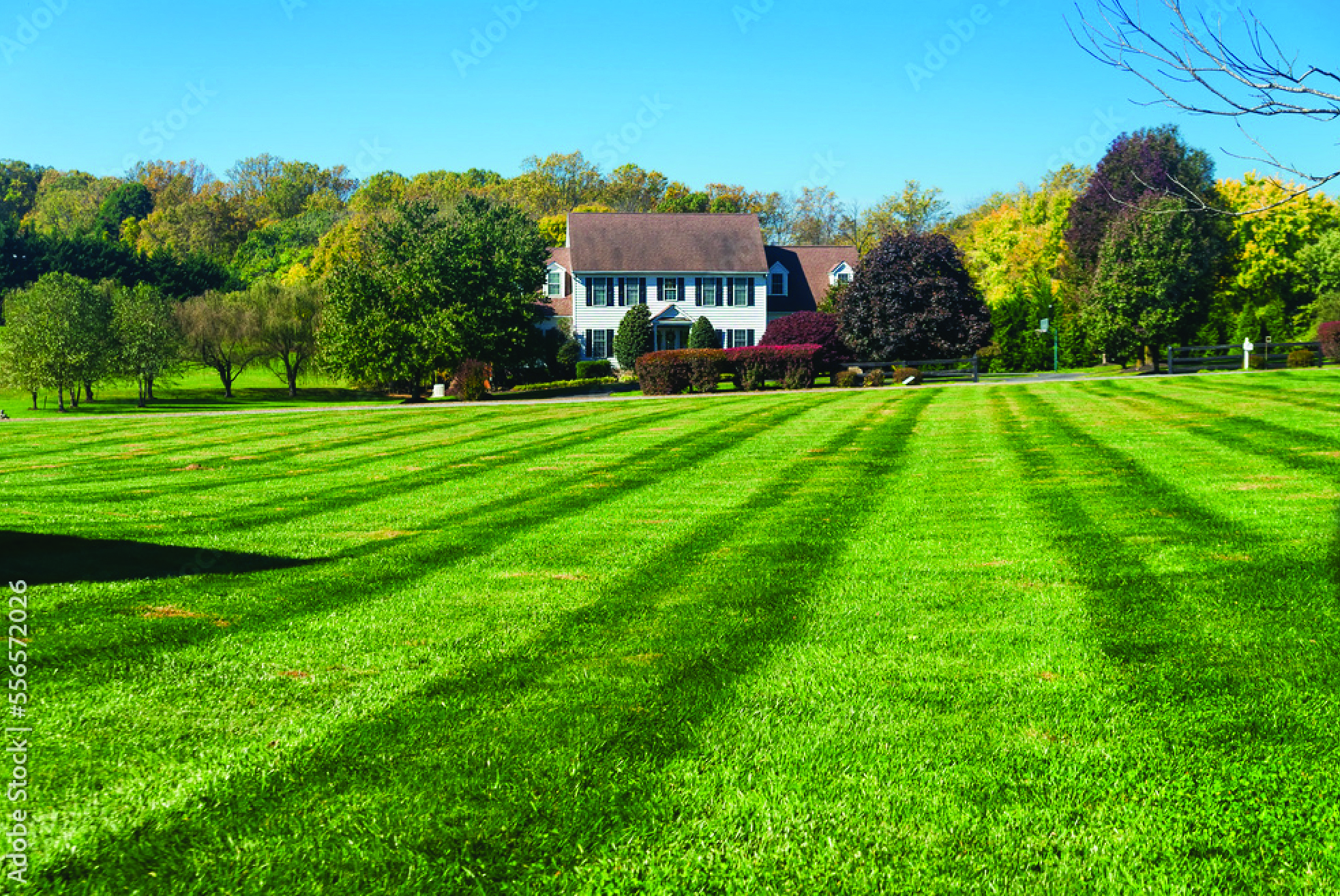
Purcellville is a small town with farm country on every side of it, and the lawns follow the same pattern. Near Main Street you find older homes on modest lots with big trees. The subdivisions on the edges of town are newer, with younger turf and more open sun. Past the town limits, lots get larger, the driveways get longer, and many homes draw water from a private well. One program will not suit all three.
Pro-Mow has worked in Loudoun County for over 35 years. Chris Gepford started the business in 1990 with a single mower, and it is still run by his family, with his son Brian Gepford as General Manager. Our office is in Dulles, and we schedule our western Loudoun routes so that Purcellville properties get a set day and enough time on site, not a quick stop squeezed in between other jobs.
The first question we ask on a Purcellville estimate is where your water comes from. It shapes almost everything else about how the lawn should be managed.
On town water. Homes inside the town limits are generally on the town system, so summer watering is limited mostly by cost and by how much you want to run it. Irrigation is a realistic option, and if a fed and properly mowed lawn still browns out every August, watering is usually what is missing. Our sister company, Superior Sprinkler Systems, has designed and installed irrigation in Loudoun County since 1991 and is run by our family from the same address.
On a private well. A well has a recovery rate, and a large lawn can use water faster than the well can supply it. On those properties, you usually cannot water your way through a dry spell. That makes the other tools more important: mowing high so the grass shades its own roots, aerating so the water that does fall soaks in, and correcting soil pH so the lawn uses what it gets. If you are thinking about irrigation on a well, Superior Sprinkler Systems can test what the well and pump actually deliver before anything gets designed.
The in-town lots around the historic center often have the oldest lawns we see in western Loudoun. The shade trees are mature, the turf has been down for decades, and the clay under it is compacted. A lawn like that usually looks tired for one of three reasons: too little light, packed soil or acidic soil holding nutrients back.
For shade, we raise the cut height under trees and overseed those areas each fall with a shade tolerant mix. Where a spot gets less than about three hours of direct sun a day, a mulched bed will look better than repeated seeding. For compaction, annual core aeration and overseeding in early fall opens the soil and puts seed in contact with it. For acidity, lime between June and September brings the pH back into range before overseeding.
Once a property gets past about an acre, the most useful thing we can do is help you decide how much of it to maintain. Every extra area on a weekly cut is a cost that repeats all season. We agree on a boundary with you at the estimate, usually around the ground you see from the house and walk on, and hold it. Areas beyond that can be cut a few times a season to keep them from turning to scrub, which costs far less than weekly service.
On open, sunny lots like these, we also recommend a grub preventative between April and early June. Grubs feed on turf roots, and on a large open lawn they can kill a wide area before anyone notices. Preventing them costs much less than repairing the damage.
We cut every turf area once a week on the same day, at a height suited to the cool season grasses grown in Northern Virginia. On larger lots we alternate the mowing direction between visits, which keeps the wheels from compacting the same two strips of ground every week. Each mowing visit includes:
A weather delay moves your visit to the next business day, Saturday included. The week after, you are back on your regular day as long as four days have passed. If you have irrigation, give the ground a full day to dry before we arrive. Heavy equipment on wet ground leaves ruts, and on a big lot they can take a long time to grow out.
Our fertilization programs start with five slow release applications six to eight weeks apart, from February through December. Spring brings a blended feed with crabgrass pre-emergent, then a second feeding with more pre-emergent. Summer is an inspection and weed control visit with no fertilizer, and it is when we decide on fall aeration. Early fall helps the lawn recover from summer, and late fall feeds the roots for a faster spring green up.
Basic Care covers those five. Basic Care Plus is seven, adding lime and grub control. Premium Care is eight and includes core aeration and overseeding. All of our fertilizer is phosphorus free. On a larger property, we only treat the maintained area you choose, which keeps the cost down and is better practice.
Mulch. Double shredded hardwood in black, brown or natural, laid at an even two and a half inches over beds that have been cleared, edged and treated with granular pre-emergent. On bigger lots, mulched beds also cover ground that would be expensive to keep in turf.
Hedge and bush trimming. Pruning for size, shape and flowering on hedges, shrubs, ornamental grasses and crape myrtles, including screening hedges along property lines.
Leaf removal. Weekly leaf removal bags the cut through the fall for mowing customers. The one time complete cleanup clears the lawn, beds, decks, patios, stairwells, fence lines and around equipment. On wooded lots, the complete cleanup is usually the better choice, because one windy weekend can drop more leaves than weekly bagging can keep up with.
Yes. We plan western Loudoun routes so Purcellville customers get a fixed weekly day and enough time on site. We do not fit a large property in between two small jobs.
Probably not the whole lawn. A domestic well recovers at a set rate, and a large lawn can outrun it. Mowing high, aerating and correcting soil pH do more on a well property than watering can. If you want irrigation near the house, our sister company can test the well first.
We measure the area you want maintained and look at access and obstacles, then give you a free written quote. A two acre open lawn can take less time than one acre broken up by trees, beds and fencing.
No. We treat the maintained area around the house that we agree on at the estimate. That is cheaper and is also better practice than treating every acre.
Disposal goes through your trash hauler or whatever service covers your property. We bag leaves rather than leaving piles at the curb.
We also serve Leesburg and Aldie. If you are not sure we cover your road, call and ask.
Call 703-957-4880 for a free Purcellville quote. Tell us if you are on town water or a well and roughly how much lawn you want maintained, and we will take it from there.
Reviewed by Brian Gepford, General Manager of Pro-Mow, Inc.
 30+ Years of Service
 Local Experts
 Friendly Service
 Fully Licensed & Insured
 Reliable & Trustworthy
 Professional & Experienced