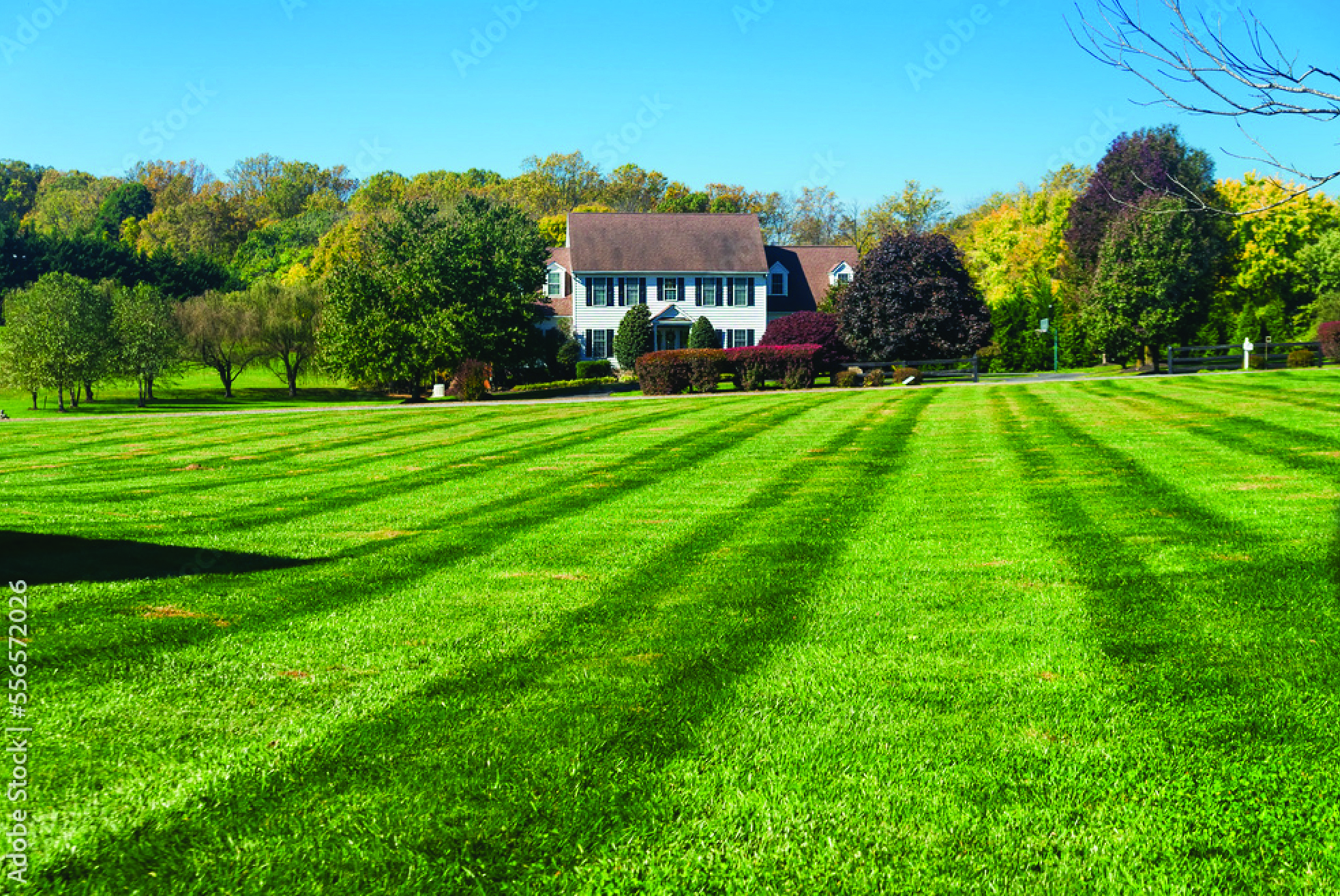
Broadlands was planned as a single community from the start, and it shows. The streets are laid out together, the yards were sodded within a few years of each other, and the association keeps a close eye on how things look. Most of the homes went up in the late 1990s and 2000s, which puts a lot of Broadlands lawns at roughly twenty years old. That is the age where a lawn that never needed much starts needing more, and where newer townhome construction near the Ashburn Metro station is adding a second, much younger group of lawns to the area.
Pro-Mow is a family business that has worked in Loudoun County for over 35 years. Chris Gepford started it in 1990, and his son Brian Gepford now runs it as General Manager. Our office on Azalea Lane in Dulles is a quick drive down the Greenway, and our crews are on Broadlands streets every week.
For the first decade or so, sod laid on new construction often looks great with very little help. Over time three things build up. The clay underneath gets more compacted. A layer of thatch builds between the grass and the soil. And the trees planted along the streets and in back yards grow large enough to shade turf that used to sit in full sun.
None of those show up all at once. The lawn just gets a little thinner each summer and a little slower to recover each fall. The fix is not more fertilizer. It is core aeration and overseeding in early fall, which pulls plugs of soil and thatch out of the ground so air, water and nutrients can reach the roots again. We seed directly into those holes with certified seed suited to Northern Virginia and your yard, along with a starter feed. On most Broadlands lawns of this age, we recommend doing it every year.
The townhomes and condos going up around the Ashburn Metro station have the opposite problem. Their turf is young, laid on graded ground with thin topsoil over subsoil packed down by construction equipment. Those lawns should get their first aeration in the second fall after the sod goes down, not in year five. They also need patience. Young turf on compacted soil needs room for roots more than it needs heavier feeding.
Broadlands was built around preserved wetlands and the Broadlands Nature Center, and a fair amount of the community’s runoff heads that way. That is one reason we use only phosphorus free fertilizer. Phosphorus runoff is the main concern in the Chesapeake Bay watershed, and a community that has made a point of protecting its wetlands should not be feeding them through the storm drains.
It is also why every mowing visit ends with blowing clippings off the driveway, sidewalk and street side instead of leaving them on the pavement for the next rain to wash away.
Many Broadlands yards are compact, and on a compact lot the details are the whole picture. The edge along the sidewalk, the trim line around the mailbox and the shape of the front beds are what neighbors notice, and what the association notices too. We edge on every visit, keep your mowing day the same each week, and treat the front of a small lot as carefully as we would a large one.
Routine mowing and treatments do not normally need association approval. Changes to the layout of a lot, such as new beds, moved edges or hardscape, usually do. Check your own covenants before making structural changes, and if the application needs a drawing, we can provide the layout.
We cut all turf areas once a week on the same day, at a height suited to the cool season grasses grown in Northern Virginia. A steady weekly cut makes grass spread sideways, which thickens the lawn, fills thin spots and keeps weeds from getting a foothold. Each mowing visit includes:
Rain pushes us to the next business day, Saturday included, and your regular day comes back the week after as long as four days separate the two visits. Irrigation should be off for a full day before we mow, so the turf is not saturated when we cut it.
Every lawn fertilization program begins with five slow release applications six to eight weeks apart. Spring brings a blended feed with crabgrass pre-emergent, then a second feeding and a second pre-emergent. Summer is an inspection and weed control visit rather than a feed, and it is when we decide whether the lawn needs fall aeration. Early fall helps the lawn recover from summer stress, and late fall builds roots for a quicker spring green up.
Basic Care is the five core steps. Basic Care Plus adds lime between June and September to balance acidic clay before fall overseeding, and a grub preventative between April and early June. Premium Care is eight steps and includes core aeration and overseeding, which makes it a good fit for the many Broadlands lawns that need aeration every year anyway.
Mulch. We clear beds of weeds and debris, recut the edge, apply a granular pre-emergent and install double shredded hardwood in black, brown or natural at an even two and a half inches. On a small front yard, fresh mulch and a clean bed line make more difference than almost anything else.
Hedge and bush trimming. Pruning for size, shape and better flowering on hedges, shrubs, ornamental grasses and crape myrtles. Foundation plantings from the original build are often due for a size reset by now.
Leaf removal. As the street trees mature, fall gets messier. Weekly leaf removal is an add on that bags leaves with every fall mowing. The one time complete cleanup handles the whole lot in a single visit, including the lawn, beds, deck, patio, stairwells, fence lines and the area around the AC unit. Loudoun County has no leaf pickup, so leaves go out bagged through your hauler or HOA.
Most likely compaction, thatch and shade, all of which build up slowly as a lawn ages. Annual core aeration and overseeding in early fall is usually the most effective fix, and raising the cut height under trees helps right away.
Plan on the second fall after the sod went down. New construction lawns sit on thin topsoil over compacted subsoil, and early aeration helps the roots get through it before the lawn starts to fail.
Not for mowing, fertilization or trimming. Changes to the layout of your lot, such as new beds or hardscape, generally need an application first. Check your covenants, and we can provide a layout drawing if the application calls for one.
Every product we apply is phosphorus free, which is the nutrient of greatest concern for runoff in the Chesapeake Bay watershed. We also blow clippings off paved surfaces so they do not wash into storm drains.
Our sister company, Superior Sprinkler Systems, does. It has designed and installed irrigation in Loudoun County since 1991 and operates from the same Dulles address as Pro-Mow, under the same family.
We also serve neighboring Ashburn, Brambleton and Stone Ridge. If you do not see your street, give us a call.
Call 703-957-4880 for a free Broadlands quote. Let us know roughly when your home was built and we will tell you what the lawn most likely needs.
Reviewed by Brian Gepford, General Manager of Pro-Mow, Inc.
 30+ Years of Service
 Local Experts
 Friendly Service
 Fully Licensed & Insured
 Reliable & Trustworthy
 Professional & Experienced